
Key benefit: Enormous CO2 savings
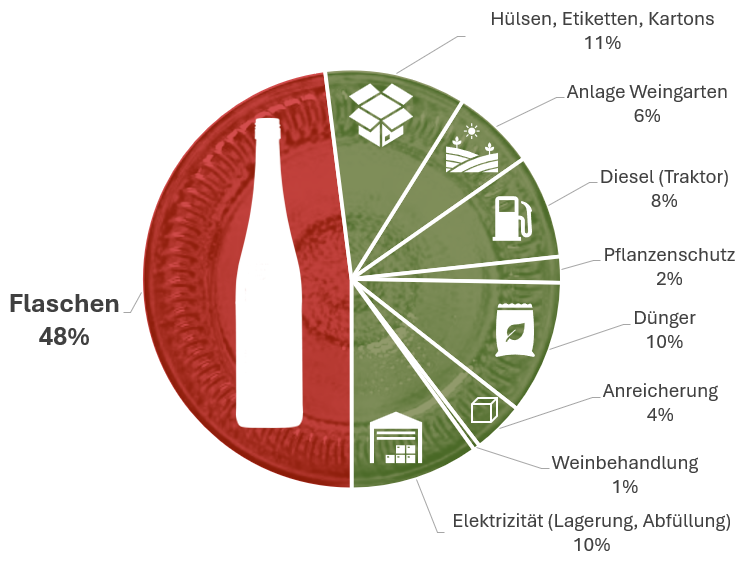
As a study by the Federal Environment Agency and the Federal Office for Viticulture and Fruit Growing* showed, packaging—in the form of single-use glass bottles—accounts for nearly half of the average winery’s carbon footprint. New figures for 2024 from the Seal of Quality for Sustainably Produced Wines Sustainable Austria indicate that single-use bottles account for slightly more than 50% of total emissions (CO2e).
The study also evaluated a number of alternatives to single-use glass: The reusable glass bottle ranked just behind the optimal option, the 20-liter reusable KEG:* It can achieve CO2e (CO2 equivalents) savings of up to 90% compared to single-use glass. Applied to operations, this would translate to total savings of up to 43%.
The popularity of the “Nachhaltig Austria” seal of approval also shows just how much the industry is already thinking about how it can contribute to achieving the national climate goals (-48% GHG by 2030**).
*Pölz, W., & Rosner, F. G. (2023). Calculation of the CO2 footprint using the example of Austrian wine. Mitteilungen Klosterneuburg, 73, 152-167. (↗)
** BMK: National Climate Plan (↗)
Benefits for …
The reusable wine bottle is …
Most sustainable: Use what is—by far—the most sustainable packaging for wine.
Energy-saving: Help save a lot of energy because recycled bottles do not need to be remelted.
Protective: Stick with glass, as it provides the best protection for your wine's quality.
convenient: Save yourself the trip to the glass recycling container.
Your Contribution to Success
As a consumer, how can you best support reusable systems?
Return reusable glass bottles to the store and get your deposit back
Do not carelessly discard bottles in the environment
Do not throw undamaged reusable glass bottles into the general waste or glass recycling bins.
Don't hold onto returnable glass bottles for too long; return them as soon as they're empty.
Do not contaminate (e.g., with foreign objects) or damage reusable glass bottles
The reusable wine bottle is …
Most sustainable: Take advantage of the single biggest lever in your business to reduce CO2 emissions: Supply your local customers with reusable products.
compelling: Create a new offering tailored to environmentally conscious consumers.
Safe: Use the first 0.75-liter wine bottle authorized for reuse with a BVS30/60 closure.
Durable: The reinforced mouth and walls allow for 12 cycles or more.
Market-opening: Comply with the reusable container requirement for wine at Green Events.
Economically: Benefit from lower system costs (reusable vs. disposable).
Greater availability: Since bottles and cases are standardized, manufacturers and retailers can produce and order based on inventory (rather than solely on a made-to-order basis).
Programming: For branded crates, the full cost of programming the bottle return machines applies. In the case of reusable bottles, these costs are shared or partially covered by the project.
A loyal partner: As a study by the Vienna University of Economics and Business (WU Wien) has shown, the return of empty containers makes the reusable system function like a (free) loyalty program.
Positive content: Use your participation in the reusable system to support your own sustainability communications.
On the Cost-Effectiveness of the Reusable System
Wine bottles have always been washed and refilled. With the emergence of single-use glass bottles in the 1980s, however, refilling steadily declined. Rising glass prices and limited availability within the bottle range as a result of the war in Ukraine recently triggered a renaissance of bottle washing—not only for traditional reusable containers (one-liter, Doppler) but above all for 0.75l single-use glass bottles.
For standard 0.75l bottles, there was previously a lack of standardized bottles approved for reusable circulation. Businesses primarily washed their own bottles. A larger, shared pool system was not feasible.
By providing new, reusable standard wine bottles and matching, neutral-colored crates as part of our initiative, winemakers can take advantage of the benefits of reusable systems.
The reusable wine bottle is …
compelling: Create a new offering tailored to environmentally conscious consumers.
High-impact: Make your product range visibly more sustainable.
Market-opening: Become the primary source of supply for green event caterers.
A loyal partner: As a study by the Vienna University of Economics and Business (WU Wien) has shown, the return of empty containers makes the reusable system function like a (free) loyalty program.
Reduce waste: Cut down on your cardboard waste.
The reusable wine bottle is …
compelling: Create a new offering tailored to environmentally conscious consumers.
Effective for marketing: Make your wine list visibly more sustainable.
Market-opening: Comply with the reusable container requirement for wine at Green Events.
Economically: Benefit from lower system costs (reusable vs. disposable).
convenient: Save yourself the trip to the glass recycling container.
Reduce waste: Cut down on your cardboard waste.