
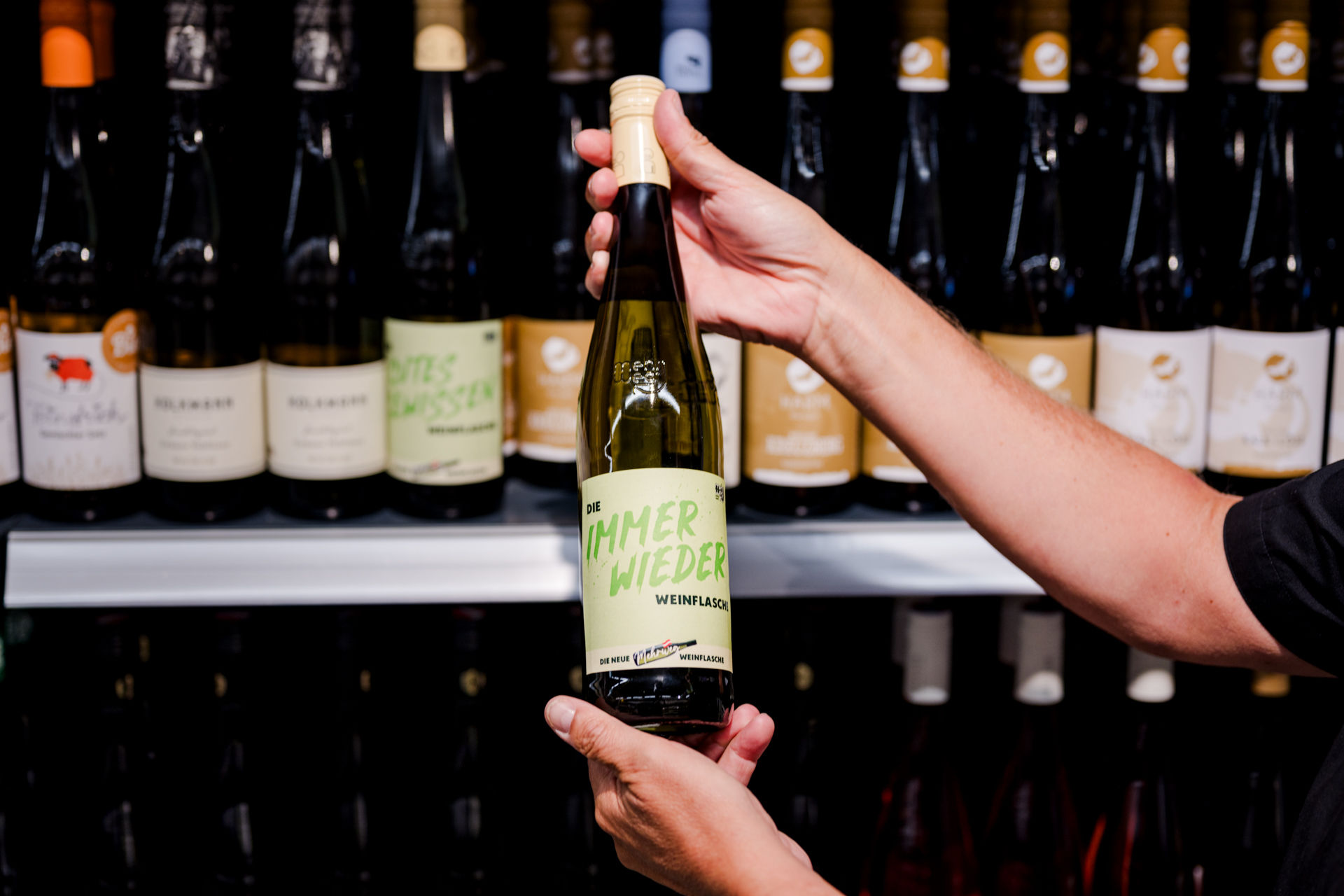
Secure the most sustainable bottle on the wine shelf now.
The highly robust Rhine wine bottles are designed for 12 cycles and more, helping to save up to 90% CO2 compared to single-use glass bottles.

Sustainability, climate protection, and resource conservation will be the decisive global issues in the coming years. The circular economy plays a central role in this. Reuse and returnable systems are key factors for a sustainable, future-proof economy and are already widely embraced by consumers (as seen with beer or milk bottles).
In the wine industry, too, closing the loop with the 0.75-liter bottle ("bouteille") can save enormous amounts of CO2.
In collaboration with winemakers and key stakeholders, the project group led by the Austrian Ecology Institute developed such an Austria-wide reusable system, which began operations in the spring of 2026.
With the market launch, the baton will also be passed to the newly formed ARGE Österreichischer Mehrweg-Weinflaschen-Pool (ÖWMP), which, as the pool’s official operator, will assume responsibility for its strategic direction and operational guidelines. The consortium has commissioned the experts at Logicycle GmbH—a subsidiary of Gesellschaft Deutscher Brunnen (GDB)—to manage and gradually expand the pool.
cycles and more
% CO2 savings compared to single-use glass bottles*
% CO2 savings at the winery*
* Figures based on the Pölz & Rosner 2023 study ( p. 9): (cradle-to-gate, 12 cycles): Single-use wine bottle (600 g) … 0.760 kgCO2/l; reusable wine bottle (600 g) … 0.052 kgCO2/l
The Objective
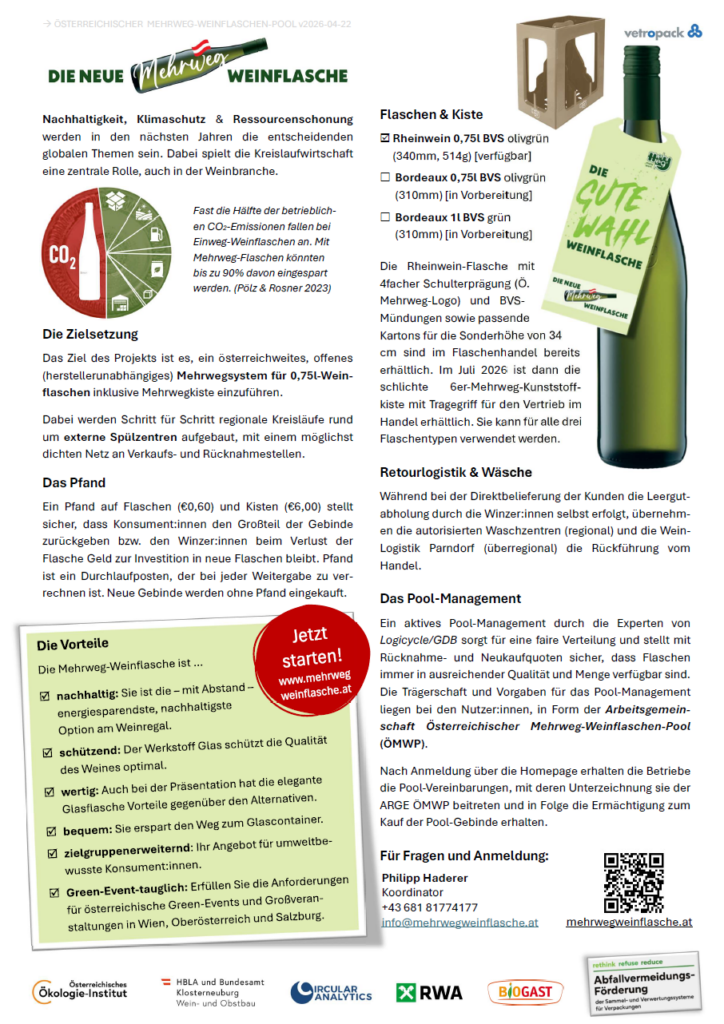
The objective of the original research project and the newly formed ARGE ÖMWP is to prepare and implement an Austria-wide, open (brand-independent) reusable pool for 0.75-liter wine bottles, including transit packaging (crates).
Step by step, regional cycles are being built around external washing centers, supported by the densest possible network of sales and return points.
A deposit on bottles and crates ensures that consumers return the majority of containers, and that winemakers retain funds to replace bottles if containers are lost.
The Closed Loop
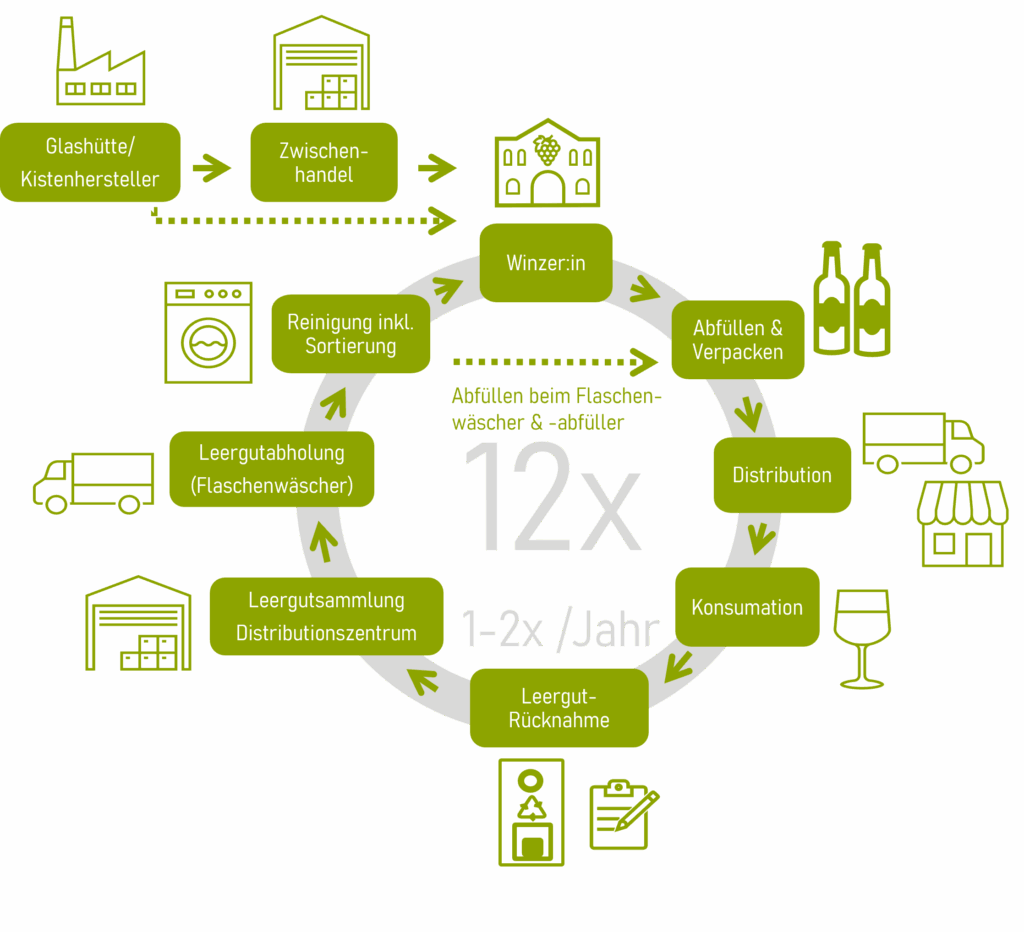
Pool bottles and crates can be sourced via authorized distributors using a so-called 'authorization'. This confirms to the point of sale that the buyer has signed the pool participation agreements and is eligible to purchase.
Once filled by the winemaker, the newly purchased reusable glass bottle is paired with the crate for the first time, reaching consumers through retail or gastronomy. The bottles move through all subsequent stages at the commercial level in the crate. Retailers can offer the bottles to consumers individually or by the crate.
Consumers return the bottlesthrough the same sales channels, either in person or using bottle return machines. When winemakers deliver directly, they take the empty bottles back in exchange for new ones. The return of empty bottles from retailers is handled regionally by washing centers and nationally by Weinlogistik Parndorf. The winemakers do not need to be involved in this process themselves—unless they want to avoid making their own return trips and paying logistics surcharges.
At the washing centers, the bottles are washed, inspected, and made available again in crates for bottling. Re-filling services are also typically offered.
The specially designed bottles are designed to withstand at least 12 cycles —with a typical reuse rate of one to two times per year. The flow rates within the system and compliance with specifications are monitored by the Logicycle pool manager.
Information Sheets
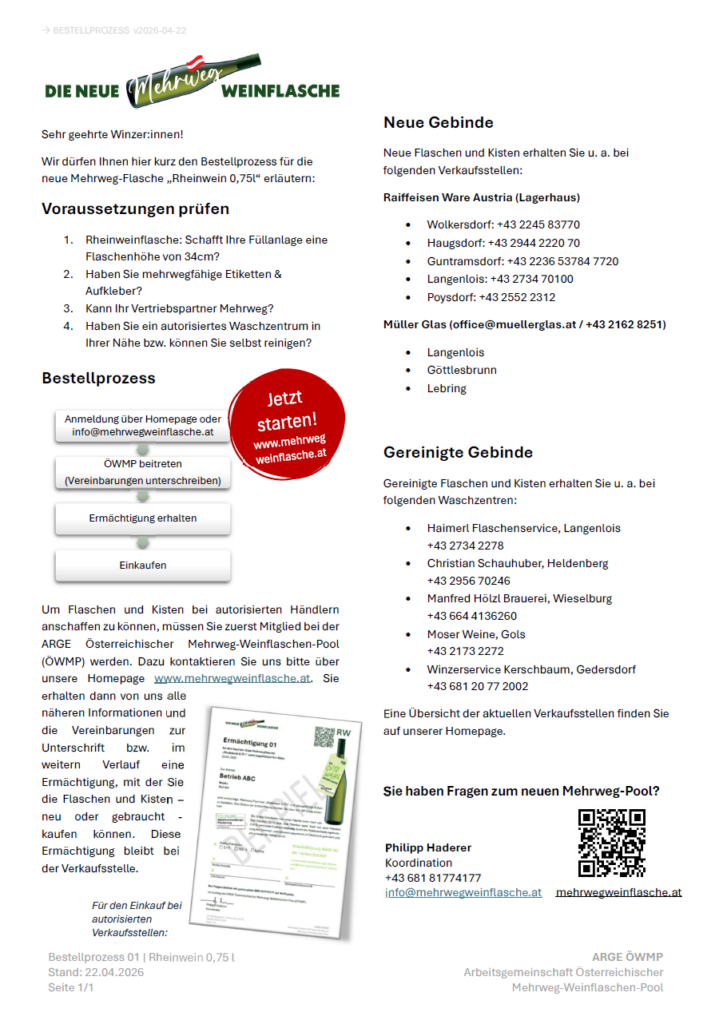
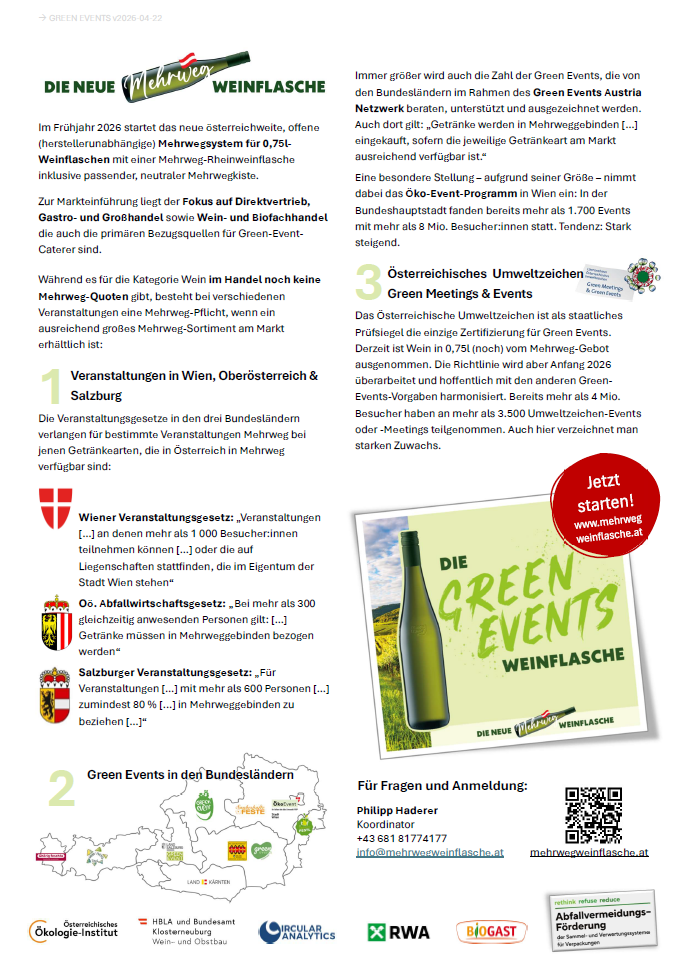
The Benefits of the New Reusable Wine Bottle
The reusable wine bottle is …
sustainable: Choose the – by far – most sustainable option on the wine shelf.
energy-efficient: Help save substantial energy because circular bottles do not need to be remelted.*
protective: Stick with glass, as it offers optimal protection for the quality of the wine.
convenient: Save yourself the trip to the glass recycling container.
The reusable wine bottle is …
Sustainable: Take advantage of the single most effective way to reduceCO2 emissions in your business: Supply your local customers with reusable containers.*
compelling: Create a new offering tailored to environmentally conscious consumers.
reliable: Use the first 0.75-liter wine bottle approved for reusable systems with a BVS30/60 closure.
Robust: Reinforced mouths and walls allow for 12 cycles and more.
The reusable wine bottle is …
compelling: Create a new offering tailored to environmentally conscious consumers.
High-impact: Make your product range visibly more sustainable.
Market-opening: Become the primary source of supply for green event caterers.
Loyalty-building: Benefit from increased customer retention.
The reusable wine bottle is …
compelling: Create a new offering tailored to environmentally conscious consumers.
Market-opening: Fulfill reusable packaging requirements for wine at all Green Events.
convenient: Save yourself the trip to the glass recycling container.
Flexible: Utilize reusable wine bottles when volume requirements are too low for reusable KEG barrels.
* Figures based on the Pölz & Rosner 2023 study ( p. 9): (cradle-to-gate, 12 cycles): Single-use wine bottle (600 g) … 0.760 kgCO2/l; reusable wine bottle (600 g) … 0.052 kgCO2/l
About the Project
The project was funded by the waste prevention grant program of the Austrian packaging collection and recycling systems (June 2023 to June 2026).
In the various working groups, the topics “Bottles & Packaging,” “Sales & Marketing,” “Logistics & Rinsing,” and “Investment and Pool Management” were addressed in collaboration with the winemakers and key stakeholders.
To facilitate the launch of the new reusable system, pool management was pre-financed for two years, and support was provided for the formation of a consortium (“ARGE Österreichischer Mehrweg-Weinflasche-Pool”).
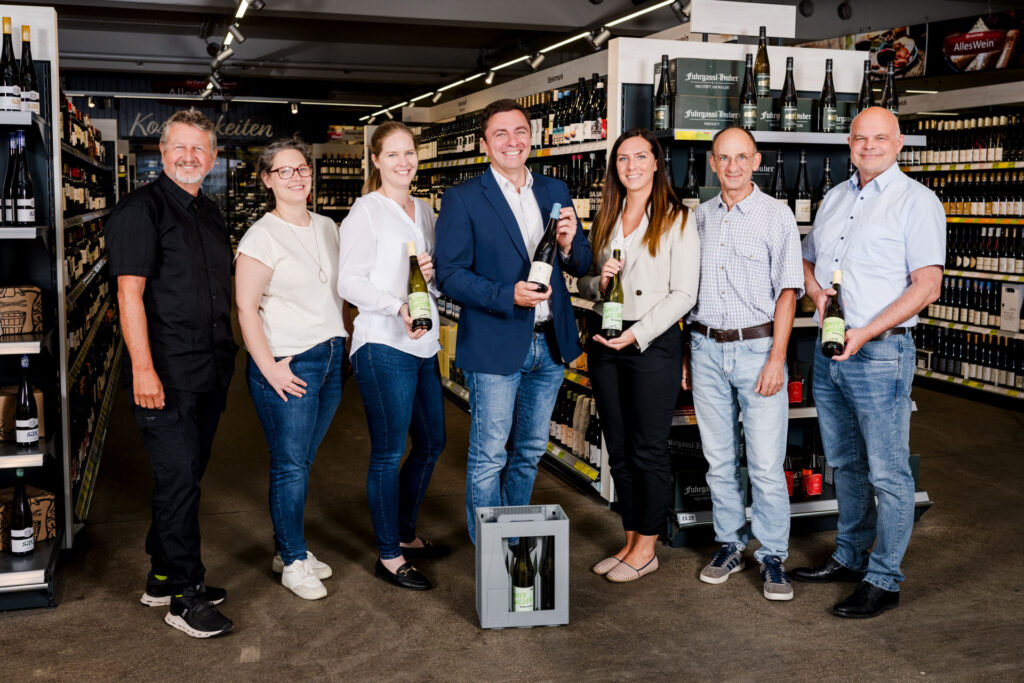
Steering Group & Stakeholders
The members of the steering group contributed their expertise to the successful planning of the containers and the pool:




They were supported during the planning process by the following organizations and companies (to varying degrees).
Finally, the following wineries also contributed their input to the working groups:
- Familienweingut Kolkmann (Bio, nachhaltig Austria)
- Weingut Mehofer Neudeggerhof (bio)
- Weingut Hager Doris & Matthias (demeter)
- Moser Weine GmbH
- Toifl GmbH & Co KG (Nachhaltig Austria)
- Gruber Röschitz (bio)
- Hofer H. u M. (bio)
- Bioweingut Schauhuber
- Wegenstein GmbH
- Weingut Schloß Fels GesmbH
- Weinbau Juditz & Werner Pölz (bio, nachhaltig Austria)
- Bio-Weinbau Graf
- Weingut Wimmer-Czerny (demeter)
Back to the Future
Wine bottles have always been washed and refilled. With the emergence of single-use glass bottles in the 1980s, however, refilling steadily declined. Rising glass prices and limited availability within the bottle range as a result of the war in Ukraine recently triggered a renaissance of bottle washing—not only for traditional reusable containers (one-liter, Doppler) but above all for 0.75l single-use glass bottles.
Until now , there have been no standardized bottles approved for reusable use for the 0.75-liter bottles. Businesses mainly washed their own (disposable) bottles. This made a larger, shared pool system impossible.
By providing new, reusable-capable wine bottles complete with matching, neutral crates within the framework of this initiative, winemakers can now benefit from the advantages of reusable systems.
Do you have questions about the new reusable system?
Please feel free to contact us:
Are you a winemaker, retailer, or bottle-washing service provider looking to be part of a sustainable, climate-fit future? Then join our reusable pool! We will supply you with all essential information, provide marketing tools, and connect you with dedicated partners.