
Key advantage: Enormous CO2 savings
As a study by the Environment Agency Austria (Umweltbundesamt) and the Federal College and Institute for Viticulture and Pomology (Bundesamt für Wein- & Obstbau)* showed, packaging in the form of single-use glass accounts for almost half of the total carbon footprint of an average winery. New figures for 2024 from the seal of quality for sustainably produced wines Nachhaltig Austria place the share of single-use bottles at slightly over 50% of total emissions (CO2e).
The study also evaluated a series of alternatives to single-use glass: Reusable glass bottles came in directly behind the optimum, the 20l reusable KEG cask:* Reusable glass bottles enable savings of up to 90% in CO2e (CO2 equivalents) compared to single-use glass. Applied across the entire operation, this represents total savings of up to 43%.
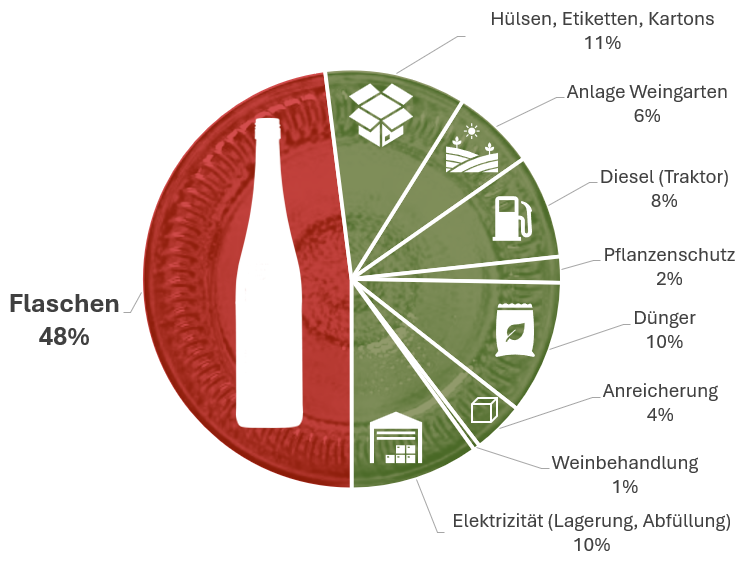
The popularity of the Nachhaltig Austria seal of quality also shows how actively the industry is already working to make a contribution toward achieving national climate targets (-48% GHG by 2030**).
*Pölz, W., & Rosner, F. G. (2023). Calculation of the CO2 footprint using the example of Austrian wine. Mitteilungen Klosterneuburg, 73, 152-167. (↗)
** BMK: National Climate Plan (↗)
Advantages for …
The reusable wine bottle is …
Most sustainable: Choose what is – by far – the most sustainable packaging option for wine.
Energy-efficient: Help save substantial amounts of energy, as bottles kept in circulation do not need to be remelted.
Protective: Rely on glass as a material, as it provides optimal protection for the quality of your wine.
convenient: Save yourself the trip to the glass recycling container.
Your contribution to success
How can you, as a consumer, best support reusable systems?
Return reusable glass bottles to retailers and collect the deposit
Do not carelessly dispose of bottles in the environment
Do not throw intact reusable glass bottles into residual waste or glass recycling bins
Do not store reusable glass bottles for too long; return them as soon as they are empty
Do not contaminate (e.g., with foreign objects) or damage reusable glass bottles
The reusable wine bottle is …
Most sustainable: Leverage the single most effective tool in your operations to reduce CO2: supply your domestic customers with reusable bottles.
compelling: Create a new offering tailored to environmentally conscious consumers.
Safe: Rely on the first 0.75l wine bottle with a BVS30/60 closure authorized for reusable systems.
Robust: Reinforced bottle mouths and sidewalls enable 12 or more rotation cycles.
Market-opening: Comply with the reusable requirement for wine at Green Events.
Cost-effective: Benefit from lower overall system costs (reusable vs. single-use).
Better availability: Standardized bottles and crates allow producers and retailers to maintain stock and order on demand, rather than producing strictly made-to-order.
Programmed: Branded crates incur full programming costs for reverse vending machines. With the standard reusable bottle, these costs are shared or partially covered by the project.
A loyal partner: As a study by WU Vienna has shown, the return process for reusable empties functions like a (cost-free) customer loyalty program.
Positive content: Leverage your participation in the reusable system to strengthen your sustainability communications.
On the economic viability of the reusable system
Wine bottles have always been washed and refilled. With the emergence of single-use glass bottles in the 1980s, however, refilling steadily declined. Rising glass prices and limited availability within the bottle range as a result of the war in Ukraine recently triggered a renaissance of bottle washing—not only for traditional reusable containers (one-liter, Doppler) but above all for 0.75l single-use glass bottles.
For standard 0.75l bottles, there was previously a lack of standardized bottles approved for reusable circulation. Businesses primarily washed their own bottles. A larger, shared pool system was not feasible.
By providing new, standard reusable wine bottles and matching neutral crates through our initiative, winemakers can effectively harness the benefits of reusable systems.
The reusable wine bottle is …
compelling: Create a new offering tailored to environmentally conscious consumers.
High-impact: Make your product range visibly more sustainable.
Market-opening: Become the primary source of supply for green event caterers.
A loyal partner: As a study by WU Vienna has shown, the return process for reusable empties functions like a (cost-free) customer loyalty program.
Waste-reducing: Significantly reduce your cardboard waste.
The reusable wine bottle is …
compelling: Create a new offering tailored to environmentally conscious consumers.
Effective marketing: Make your wine list visibly more sustainable.
Market-opening: Comply with the reusable requirement for wine at Green Events.
Cost-effective: Benefit from lower overall system costs (reusable vs. single-use).
convenient: Save yourself the trip to the glass recycling container.
Waste-reducing: Significantly reduce your cardboard waste.