
A robust system for many cycles
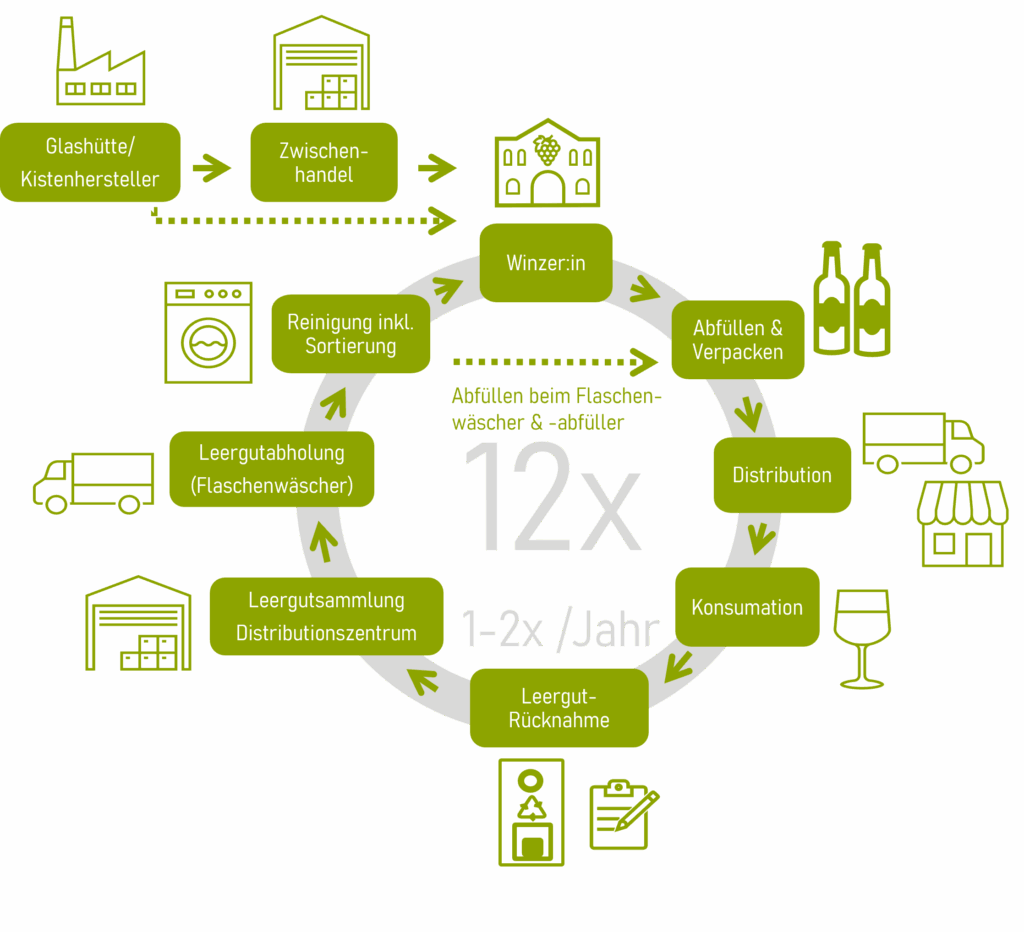
The new reusable wine bottle was developed for at least 12 cycles. In practice, this means: with typical use of one filling per season, the bottle lasts for more than a decade. Winemakers with multiple filling dates per year and a fast return of empties can even achieve two to three cycles per year.
Sale to licensed users
Pool bottles and crates can be obtained through licensed distributors with a so-called ‘authorization’. This confirms to the point of sale that the purchaser has concluded a licensing agreement with the pool and is sourcing the quantities specified therein. Winemakers receive this authorization directly from the pool coordinator.
Bottle and crate united in the cycle
Bottles and plastic crates are initially sourced separately and only combined after bottling. From that point on, the bottles remain continuously in the crate throughout all subsequent process steps – from dispatch to the return of the empties.
Return logistics
Filled wine bottles are delivered in the customary manner, either directly or via retail to the gastronomy sector or end consumers. After consumption, the empty bottles are returned via the same distribution channels – similar to mineral water or juice bottles. A key difference: in the wine sector, return logistics are handled by washing centers and specialized wine logistics providers.
Washing and refilling available at the washing center
In the washing centers, bottles and crates are cleaned and made available again as a unit. Many of these facilities also have bottling plants and can refill and label the wine delivered from winemakers' tanks directly into the cleaned bottles – an efficient cycle with minimal logistical effort for winemakers.
Coordination within the pool system
Logicycle GmbH – a subsidiary of Genossenschaft Deutscher Brunnen – acts as the central pool manager to ensure that:
- bottles return to the correct bottlers after each cycle,
- sufficient quantities and qualities are available,
- and shrinkage (e.g., due to loss in the market or rejection) is distributed fairly among all participants.
Why the crate is indispensable
For retailers and bottle manufacturers, it is essential that the bottle remains in the plastic crate throughout. The crate facilitates sorting, storage, and transport, while simultaneously protecting bottle walls and finishes, contributing significantly to bottles achieving many cycles.
Return logistics
Return
Consumers return their collected empties either directly to the point of sale or to other participating businesses. Depending on the technical equipment, returns are accepted either via reverse vending machines or manually.
Collection by Wein-Logistik Parndorf
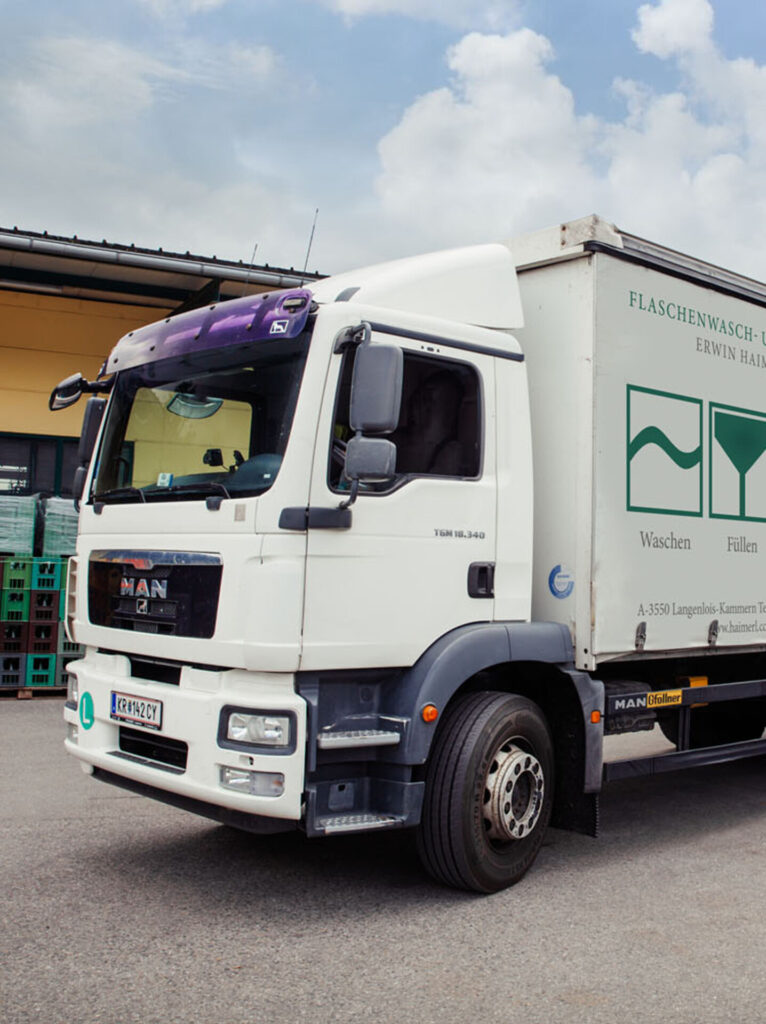
In retail, bottles are collected directly in the plastic crates and then bundled at distribution centers ready for collection. The central contact partner for retail is Wein-Logistik GmbH in Parndorf (↗). It is supported locally by the proprietary logistics of the washing facilities.
In some cases, winemakers also handle the return of empties themselves – for example, if:
- they clean their bottles in their own facility, or
- they carry out transport on behalf of a washing facility.
Pre-sorting at all stages
Thanks to the clearly visible embossing on the bottle shoulder, the reusable wine bottle is distinctly recognizable. Therefore, returned empties are expected to be pre-sorted – containing exclusively the designated reusable bottles without mixing with third-party containers.
Pool coordination
The reusable system for the new reusable bottle operates as a pool system: wineries throughout Austria use standardized, neutral bottles and crates. Because the businesses purchase these themselves, the winemakers are also the owners of the shared reusable pool.
Pool management acts as a neutral trustee responsible for the organizational management of the system. Its task is to ensure smooth operations – in particular, that bottles and crates are available in sufficient quality and quantity. Furthermore, it ensures that all participating businesses contribute proportionately to the costs of shrinkage and the acquisition of new containers.
The know-how and background systems for the new Austrian Reusable Wine Bottle Pool (ÖWMP) are provided by Genossenschaft Deutscher Brunnen (GDB) via its subsidiary Logicycle. As there was previously no experience with an open, industry-wide pool in Austria, the steering committee and key stakeholders opted for pool coordination by experts from the world's largest reusable packaging market.
The sponsorship and governance of the pool are assumed by domestic winemakers and bottlers. They are therefore responsible for the strategic orientation and operational setup of the pool – including the rights and obligations of pool participants.
Reporting inventory and filling quantities
Depending on the size of the business, the pool collects data from pool participants annually (inventory, fillings, rejections, and supplementary purchases). This data is processed confidentially and is used, among other things, to calculate shrinkage across the entire system.
In addition, it monitors compliance with applicable regulations and regularly issues updated quotas for the use of bottles and crates (cleaned vs. new procurements). Without this steering function, empty container returns risk being unevenly distributed, resulting in surplus inventories for some participants while others face shortages. In the worst case, inventories requiring balance could be located at opposite ends of Austria, necessitating additional transport for balancing. This applies not only during periods of high demand when all participants require empty containers simultaneously, but also during phases when demand for empties is low and businesses wish to keep their inventory levels minimal.
Likewise, pool management ensures consistent quality of bottles and crates within the system, preventing bottles that no longer meet visual or functional standards from being decommissioned too late.
Transparent data – fair distribution
The pool coordinator regularly collects relevant operational data from participants – annually or quarterly depending on size. This includes:
- current inventories,
- bottled quantities,
- rejected containers,
- any supplementary purchases
This data is processed confidentially and serves, among other purposes, to calculate shrinkage across the entire system. Based on this, the contribution required from each participant to replenish the pool is determined.
Steering prevents bottlenecks and surpluses
Another central task of the pool coordinator is the active steering of circulation: it regularly issues updated quotas, e.g., regarding the ratio of reused to newly procured containers. Without this steering function, an uneven distribution of empty containers could occur – for instance, if one facility accumulates excess inventory while another faces shortages.
Particularly during times of high demand (such as the start of the bottling season) or declining demand (e.g., during quieter months), it is essential to coordinate logistics centrally. Otherwise, costly balancing transports across Austria would need to be organized – resulting in considerable additional effort for all parties involved.
Ensuring quality throughout the cycle
A further focus is quality assurance within the system. The pool coordinator ensures that bottles and crates that no longer meet visual or functional requirements are decommissioned in good time and replaced. This permanently preserves the value and reliability of the reusable system.
License fees
The costs for pool coordination are allocated as license fees based on the number of fillings and will amount to a low single-digit cent amount per filling. This allows businesses with smaller bottling volumes to benefit from the economic advantages of the reusable system as well. License fees are collected periodically by the pool coordinator.
These fees are waived for the first 24 months (until 2028) – thanks to waste prevention funding from Austrian collection and recovery systems. Thereafter, annual costs of €200 to €800 can be expected, depending on the volume of bottles filled.
The deposit
The deposit is charged for the first time upon sale by the bottler and then applies at every stage of the cycle. This means winemakers purchase new empty containers without a deposit and sell the filled wine bottles with a deposit. Each subsequent buyer pays the deposit upon receipt and invoices it upon handover to the next buyer. The deposit is subject to 20% VAT.
| Gross (including 20% VAT) | Net | |
|---|---|---|
| Bottle deposit | € 0,60 | € 0,50 |
| Crate deposit | € 6,00 | € 5,00 |
A (high) deposit increases the return rate and provides winemakers with fresh capital for repurchasing if containers are not returned by consumers. Economically, it makes sense for deposit values to roughly match purchasing prices for new containers. For this reason, domestic breweries, for example, raised the deposit for 0.5l beer bottles from 9 to 20 cents at the beginning of 2025.
A quick side note: bottles and crates for the new reusable wine bottle are considerably more expensive to purchase than beer bottles due to higher material input and lower production volumes; therefore, a uniform deposit matching beer bottles is not feasible.
Bottle cleaning
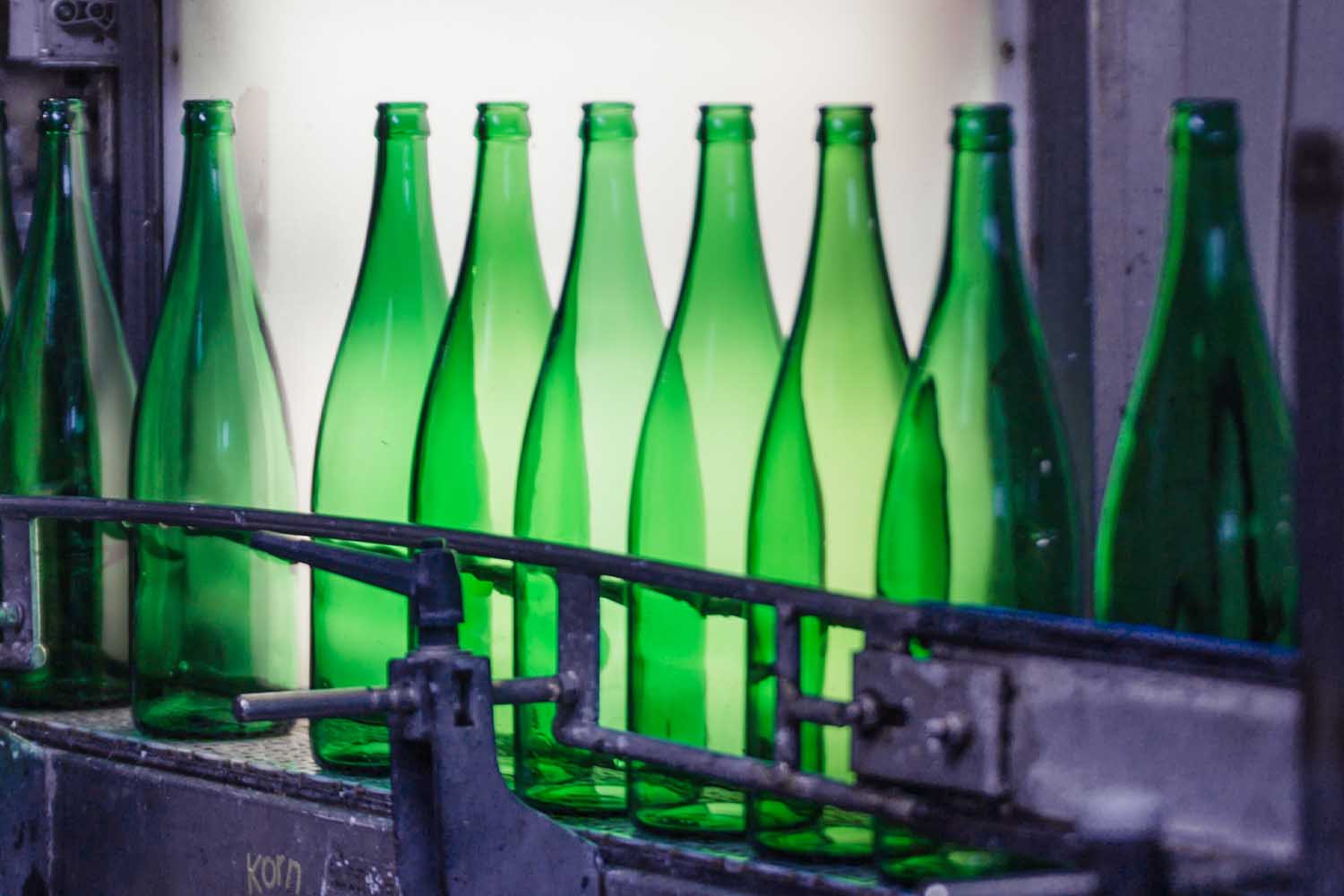
For a long time, dedicated bottle-washing machines could be found in many wineries. Due to the dominance of single-use glass bottles, most of these facilities have since been dismantled. In rolling out the new reusable system, we are therefore primarily collaborating with high-capacity, external washing centers across the wine-growing regions that already offer contract washing—and typically contract bottling as well.
Because bottles AND crates are standardized in the new reusable system, new possibilities emerge: while traditional contract washing requires winemakers to only have their own containers cleaned within a closed loop, it is now possible to exchange bottles and crates directly. Winemakers no longer have to wait for the cleaning process, but can immediately swap dirty containers for clean ones at the washing center.
Because winemakers no longer handle only their own bottles, quality control within the cycle becomes increasingly important. A key objective is therefore to support existing washing centers in expanding quality assurance:
Automated bottle inspection can detect even minor damage that might not be visible to the naked eye. Machinery also ensures better harmonization when rejecting excessively worn bottles.
Even though bottles air-dry on their own after being treated with warm lye or warm water during cleaning, an additional drying stage enhances the results.
Equipping facilities with efficient, mechanical sleeve removers, where not already present.
Since washing centers may only deliver flawless bottles to their clients, the highest reject rate occurs during inspections before and after washing. A share of 5% damaged bottles is factored into the service pricing. Any additional rejections are generally invoiced to the empty container suppliers.
As part of the project, we have collaborated with a group of washing facilities that collectively contribute extensive experience and technical expertise:
Haimerl Flaschenservice (↗), Langenlois
Christian Schauhuber Flaschenservice (↗), Heldenberg
Manfred Hölzl Brewery (↗), Wieselburg
Moser Weine (↗), Gols
Winzerservice Kerschbaum (↗), Gedersdorf near Krems
Naturally, the reusable system is open to additional washing centers or private washing facilities. If there is interest in joining the reusable system, new washing facilities are evaluated prior to deployment. For this purpose, novel analytical devices from project partner Vetropack are used to readily measure the mechanical stress exerted on the bottles.