
Bottles & Accessories
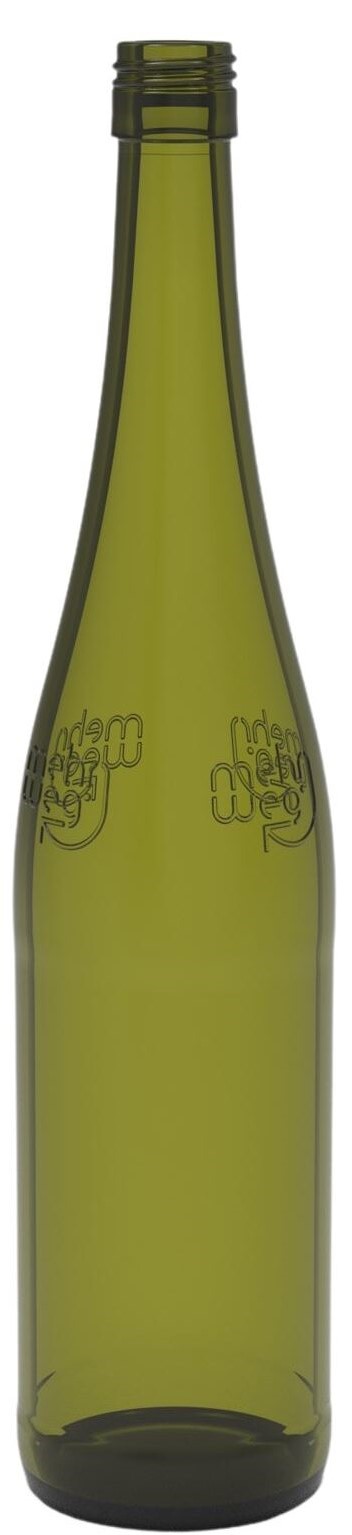
Available from April 2026:
Reusable Rhine wine 0.75 l
Weight: 514 g
Height: 340 mm
Diameter: 76 mm
Mouth: BVS 30/60
Color: olive
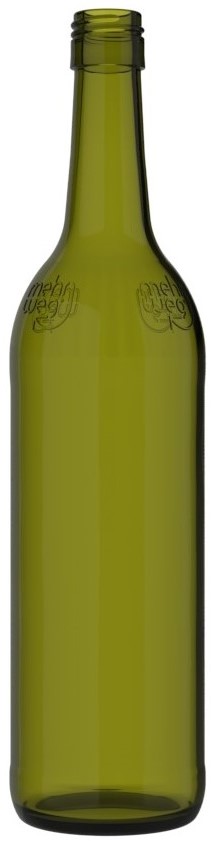
In planning:
Reusable Bordeaux 0.75 l
Weight: 495 g
Height: 310 mm
Diameter: 76 mm
Mouth: BVS 30/60
Color: olive
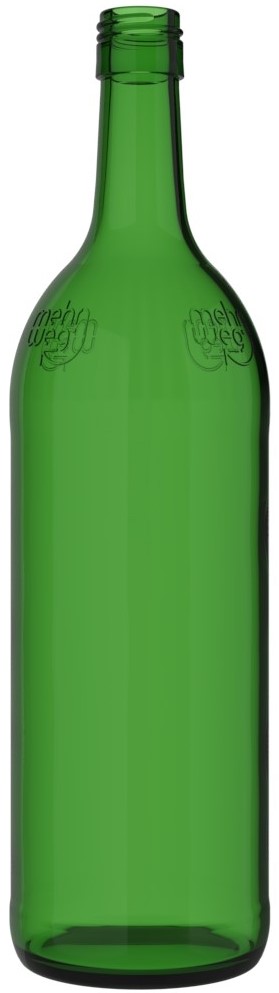
In planning:
Reusable Bordeaux 1 l
Weight: 575 g
Height: 310 mm
Diameter: 85 mm
Mouth: BVS 30/60
Color: standard green
Sample bottles are available from bottle merchants. Technical drawings can be requested here.
Secure the most sustainable bottle on the wine shelf now.
The highly robust Rhine wine bottles are designed for 12 cycles and more, helping to save up to 90% CO2 compared to single-use glass bottles.
The bottles
Why olive green?
Olive green is the most common bottle color in viticulture and is resistant to discoloration caused by repeated washing. A clear rosé bottle is currently not planned for economic reasons due to the additional sorting effort.
Robust and suitable for reverse vending machines
The reusable bottles are slightly heavier than single-use bottles. Reinforced walls and bottle finishes allow for at least 12 cycles. The slightly increased bottle height also improves recognition in reverse vending machines.
Compatible with existing bottling equipment
The bottles are designed for the BVS 30/60 screw cap (Stelvin) commonly used in Austria. Technical adjustments during bottling are therefore not necessary.
Easily recognizable
The reusable logo of the Austrian Federal Economic Chamber is embossed four times on the bottle shoulder. This ensures that the bottles are easily recognized on the shelf and during empty bottle collection.
Label protection and contact rings
Bulges above and below the label area protect the labels during transport and on conveyor belts. At the same time, they limit friction to two narrow rings and reduce extensive scratching.
Cold-end coating
A polyethylene dispersion improves sliding properties on conveyor belts and supports machine handling during bottling and washing. Since this protection degrades after the initial washes, crates should be used and the bottles handled with care.
1-liter bottle also planned
As part of the project, two olive-green 0.75-liter reusable bottles were developed—in the standard Rhine wine and Bordeaux shapes. A Burgundy bottle is currently not planned, as sales volume in this segment is still too low. At the request of many winemakers, a 1-liter reusable bottle in Bordeaux shape was also developed. It is 310 mm high, also uses the BVS 30/60 closure, and is available in standard green.
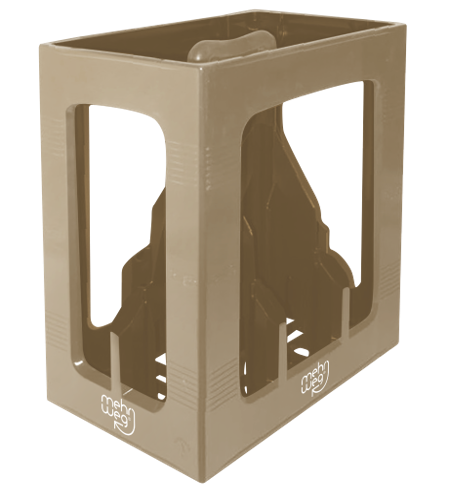
The crates
For the initial phase of the market launch – with a strong B2B focus – a modified standard crate with a carrying handle is being used. It is more cost-effective than the premium crate planned for the medium term, which will then also be used more widely in retail. In terms of "look and feel" and external dimensions, the new crate already anticipates the premium crate.
All three new reusable bottles fit into the crate: both the 340 mm high Rhine wine bottle and the 85 mm wide 1 l Bordeaux bottle.
The crate will be available in October 2026.
Use of cardboard boxes
Since the crates will only be available at a later date, cardboard boxes can also be used for the launch. Cardboard boxes suitable for the special height of the Rhine wine bottle are available from both RWA (Lagerhaus) and Müller Glas. Boxes for premium Rhine wine bottles (35 cm height) can also be used, but severely limit stackability.
In general, the long-term use of cardboard boxes is only permitted where wine moves in closed loops, meaning winemakers deliver and collect the bottles themselves. In retail and larger hospitality businesses, crates must be used – due to their advantages in storage and transport as well as bottle protection.
The closures
All reusable wine bottles in the project feature a mouth compatible with the industry-standard BVS 30/60 closure. This is globally unique for reusable wine bottles, which previously only used corks, crown corks, or MCA (juice) closures.
The BVS 30/60 closure is available with two different types of liners:
Wads (flat gaskets)
Foamed sealing compounds
Both variants meet the generally expected requirements:
Liquid tightness (when stored horizontally).
Gasdichtheit bei Verwendung von CO2 im Füllgut (< 2 gCo2/l).
Storage life of up to 4 years with tin insert.
Good adaptation of the seal to the mouth profile (sealing surface).
Due to the presence of sealing compound in the transition area from the sealing surface to the transition radius core diameter, the foamed compound (top and side) additionally offers slightly more security against…
Mechanical contact (bottle handling during filling and storage)
Minor contact dents on the closure
Minor damage to the bottle's sealing surface and resulting leaks
In addition, bottles with foamed compound can be laid down more quickly after the filling process.
The labels
The ideal label for reusable systems is resistant to ice water and condensation, but detaches easily and in one piece from the reusable container during commercial alkaline washing. The label material itself must therefore be alkali-stable and easily recyclable, or consist of a high proportion of recycled material. The optimal adhesive for this is hot-water soluble, recyclable, and stored under optimal conditions.
Many standard self-adhesive labels do not meet the requirements. If they are applied to reusable bottles, the washing facility must reject these bottles as single-use containers and charge the distributor accordingly. The good news: Reusable-compliant products—including self-adhesive labels—have been in use for several years and are available from all label manufacturers.
The ideal label for reusable bottles must meet two key requirements: It should be resistant to ice and condensation water—yet detach easily and completely from the container in one piece without residue during commercial caustic washing.
This requires a label material that:
- is caustic-resistant,
- is easily recyclable or contains a high proportion of recycled content,
- and is coated with a hot-water-soluble, recyclable adhesive that is stored properly.
It also requires an adhesive that:
- is hot-water-soluble, and
- dissolves completely in combination with additives (e.g., NaOH + additives).
It is also advantageous if the adhesive is not over-aged (max. 24 months) and has not been exposed to the elements. This is not strictly mandatory, but it helps avoid unnecessary disruptions in the washing process.
Caution with standard self-adhesive labels
Many conventional self-adhesive labels do not meet these requirements. If they are applied to reusable bottles nonetheless, these bottles cannot be reused. They must be sorted out like single-use containers and billed to the distributor at deposit value.
The good news: Solutions are available
Reusable-compatible labels—including self-adhesive variants—have been available on the market for years and can be sourced from all standard label manufacturers. It is therefore worth deliberately selecting products suited for reusable systems.
Avoid expensive downcycling:
Have your labels checked by the bottle washer before use!
Typical problems with unsuitable labels
Paper pulp formation
If non-caustic-resistant label paper is used, it swells during washing and loses its structure. The dissolved paper particles accumulate in the nozzles and lines of the washing machine. This leads to downtime, additional cleaning effort, and in the worst case, damage to the system.
Adhesive residue on the bottle
Another problem: While the label paper dissolves in the caustic solution, the adhesive remains stuck. Complete removal is then only possible manually and with chemical additives.
Label types
For small to medium batches, pressure-sensitive labels are often applied—by hand or with a labeling machine. Special attention should be paid to optimal storage conditions without excessive storage times, as adhesive quality degrades over time. Proper contact pressure is required to activate the pressure-sensitive adhesive.
Recycling tip: Liner material can now be recycled—not with standard paper, but as a dedicated collected fraction. Contact your label suppliers for details.
Variants
wet-strength and caustic-resistant paper
transparent polypropylene film (PP film)
white polypropylene film (PP film)
transparent polyethylene film (PE film) (rare)
For larger print runs, labels are generally applied using wet-glue labeling. This means a wet-glue machine first applies the wet glue to the label during the labeling process before it is pressed onto the bottle.
Wet-glue labels wash off well. It is only necessary to ensure that the paper is wet-strength and caustic-resistant.
For small batches, dry-gummed labels are occasionally used. The adhesive is activated by moistening the back of the label (like a postage stamp).
| Self-adhesive labels | Wet-glue labels | Dry-gummed labels | |
|---|---|---|---|
| Adhesive: caustic-soluble | product-dependent | yes | yes |
| Label: wet-strength & caustic-resistant | product-dependent | product-dependent | product-dependent |
| Waste paper recycling | yes | yes | yes |
From extensive studies by project partner Securikett involving more than 600 different bottle-label material-adhesive combinations, the following insights were gained:
Purchasing advice
- Commercial self-adhesive papers labeled as washable are suitable for washing, but are usually not or poorly suited for the ice bucket test. Behavior in the cellar, refrigerator, or during commercial transport (refrigerated trucks) should be tested.
- Polypropylene films with caustic-soluble adhesive (washable UV acrylate or a washable rubber hot melt) meet the requirements during washing AND in the ice bucket test, but create a mixed fraction in the caustic solution with dissolved paper labels that cannot be recycled.
- Used bottles achieve good wash-off results even when their adhesives are not specified for washing. This is related to a cold-end coating (see above) that has already been partially or completely removed. Therefore, a larger number of lower-cost label materials are viable for used bottles, which often also pass an ice bucket test. Feasibility must always be tested beforehand. Adhesives specified as 'washable from plastic' or as 'strongly permanent' must be tested before use on reusable glass.
- Adhesives specified as 'washable from plastic' or as 'strongly permanent' must be tested before use on reusable glass.
- Adhesives applied in stripes increase the surface area exposed to the caustic solution and can improve wash-off performance.
- Important: Quality, price, reusable, and deposit stickers should also be washable!
Storage instructions
- Rain: On commercial self-adhesive papers applied to glass containers, (repeated) exposure to moisture followed by drying out has a negative impact on wash-off capability. Moistening immediately prior to washing, on the other hand, has an extremely positive effect.
- Sunlight: Exposing labeled empty containers to direct UV radiation through outdoor storage is also detrimental to wash-off capability.
Printing instructions
- Tests have shown that open-pored, closed, and wet-strength papers are all washable.
- Printing (UV inks, varnishes) – especially when applied full-surface – can impact the wash-off results.
- The effects of cold or hot foil stamping must be evaluated on an individual basis.
- Laminates should be avoided for use on reusable bottle labels.
Given the wide variety of potential label options, we recommend a consultation with your label suppliers or bottle washing facility.