
A robust system designed for many cycles
The new reusable wine bottle was designed to last for at least 12 cycles. In practice, this means that with typical use— one filling per season —the bottle will last for over a decade. Winemakers who fill their bottles several times a year and have a quick return of empties can even achieve two to three cycles per year.
Sales to Licensed Users
Pool bottles and cases can be purchased through licensed retailers with a so-called “authorization.” This authorization confirms to the point of sale that the buyer has entered into a license agreement with the pool and is purchasing the quantities specified therein. Winemakers receive this authorization directly from the pool coordinator.
Bottles and Crates Combined in the Recycling Cycle
Bottles and plastic crates are initially sourced separately and are only combined after filling. From that point on, the bottles remain in the crate throughout all subsequent process steps—from shipping to the return of empties.
Return Logistics
Filled wine bottles are delivered via the usual channels—either directly or through retailers—to restaurants and bars or to end consumers. After consumption, the empty bottles are returned through the same distribution channels—similar to how mineral water or juice bottles are handled. One key difference: In the wine industry, reverse logistics are handled by bottle-washing facilities and specialized wine logistics providers.
Cleaning and refilling availableat the bottling center
At the bottling centers, bottles and cases are cleaned and returned as a complete set. Many of these facilities also have bottling lines and can directly bottle and label the wine delivered from the winemakers’ tanks into the cleaned bottles—an efficient process that minimizes logistical effort for the winemakers.
Coordination in the Pool System
Logicycle GmbH—a subsidiary of the Genossenschaft Deutscher Brunnen—acts as the central pool manager to ensure that:
- the bottles return to the correct bottlers after circulation,
- sufficient quantities and quality are available,
- and that any shortfall (e.g., due to market losses or outflows) is distributed fairly among all participants.
Why the crate is indispensable
For retailers and bottle manufacturers, it is crucial that the bottles remain in the plastic crate at all times. The crate makes sorting, storage, and transportation easier, while also protecting the bottle walls and necks, and plays a key role in ensuring that the bottles can be reused many times.
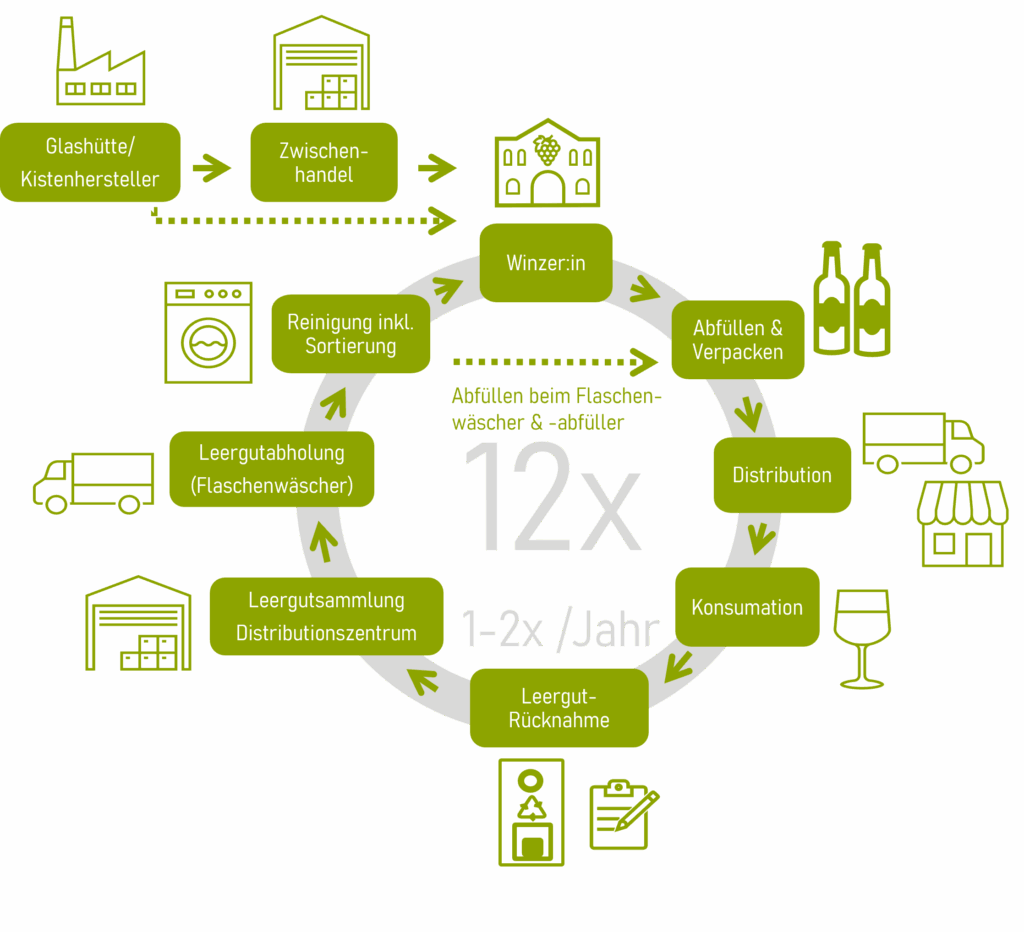
Return Logistics
Returns: Consumers return their collected empty containers either directly at the point of sale or at other participating businesses. Depending on the technical equipment available, returns are processed either through reverse vending machines or manually.
Pickup by Wein-Logistik Parndorf
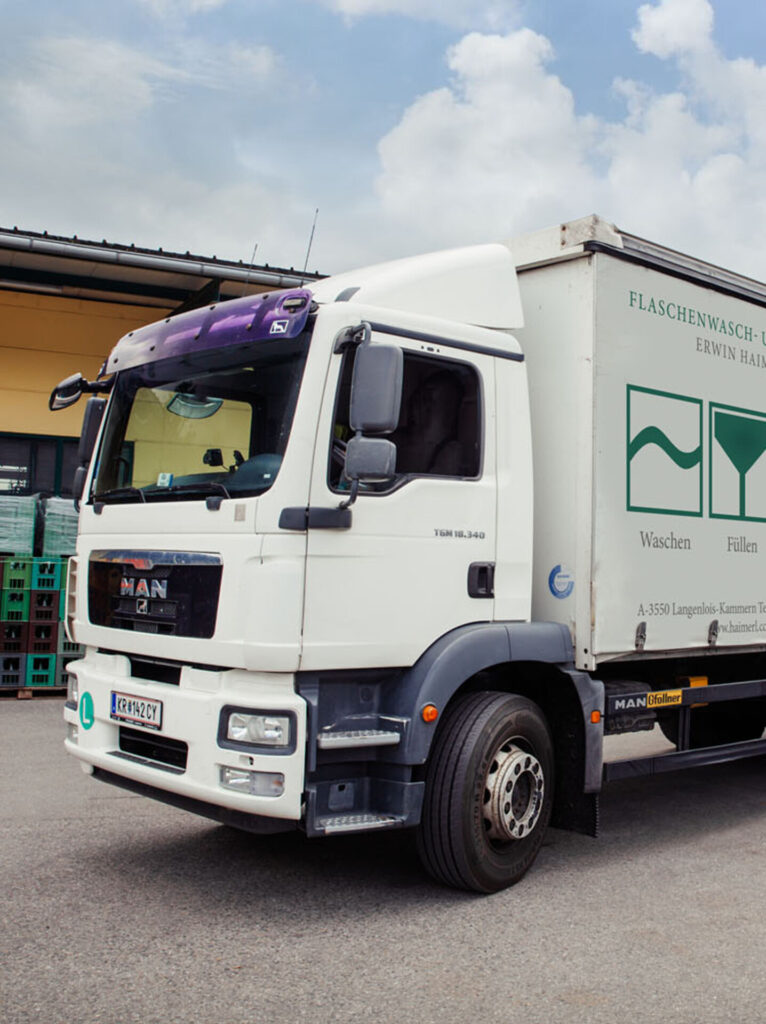
In retail stores, the bottles are collected directly into plastic crates and then bundled at the distribution centers and made ready for pickup. The central point of contact for retailers is Wein-Logistik GmbH in Parndorf (↗). It is supported locally by the in-house logistics teams of the glass recycling facilities.
In some cases, winemakers also handle the return of empty bottles—for example, when:
- they clean their bottles at their own facility, or
- they carry out the transport on behalf of a dishwashing service.
Pre-sorting at all stages
Thanks to the clearly visible embossing on the shoulder of the bottle, the returnable wine bottle is easily recognizable. Therefore, returned empties are expected to be pre-sorted—that is, to contain only the designated returnable bottles, without being mixed with other types of containers.
Pool Coordination
The returnable system for the new returnable bottle operates as a pool system: wineries throughout Austria use standardized, neutral bottles and crates. Since the wineries purchase these themselves, the winemakers are also the owners of the shared returnable pool.
A pool management organization acts as a neutral trustee and is responsible for the organizational management of the system. Its role is to ensure that operations run smoothly—in particular, that bottles and crates are available in sufficient quantity and of adequate quality. It also ensures that all participating businesses contribute their share of the costs associated with shrinkage and the replacement of containers.
The expertise and back-end systems for the new Austrian Reusable Wine Bottle Pool (ÖWMP) are provided by the Genossenschaft Deutscher Brunnen (GDB) through its subsidiary, Logicycle. Since Austria has had no previous experience with an open, industry-wide pool, the steering committee and key stakeholders opted to have the pool coordinated by experts from the world’s largest reusable market.
The pool is managed by local winemakers and bottlers. They are therefore responsible for the pool’s strategic direction and operational structure—including, for example, the rights and obligations of pool participants.
Reporting of Inventory and Refill Volumes
Depending on the size of the business, the pool collects data from pool participants annually (inventory, refills, removals, and replenishments). This data is processed confidentially and is used, among other things, to calculate shrinkage across the entire system.
In addition, it monitors compliance with applicable regulations and sets regularly updated quotas for the use of bottles and crates (cleaned vs. new). Without this oversight function, there is a risk that returns of empty containers will be unevenly distributed, leading to excess inventory for some participants while others fall short. In the worst-case scenario, the stocks that need to be balanced would be located at opposite ends of Austria and would require additional transport to balance them out. This applies not only to periods of high demand, when all participants need empty containers at the same time, but also to phases when the demand for empty containers is low and businesses want to keep their own inventory levels low.
Pool management also works to ensure consistent quality of the bottles and crates in the system and to prevent bottles that no longer meet visual or functional requirements from being removed too late.
Transparent Data – Fair Distribution
The pool coordinator regularly collects the relevant operational data from the participants— either annually or quarterly, depending on the size of the pool. This includes:
- Current inventory,
- quantities filled,
- Ejections,
- any additional purchases
This data is processed confidentially and is used, among other things, to calculate the loss across the entire system. This data is also used to determine how much each participant must contribute to replenish the pool.
Control prevents bottlenecks and surpluses
Another key responsibility of the pool coordinator is to actively manage the circulation of containers: The coordinator issues regularly updated quotas, such as the ratio of reused containers to new ones to be procured. Without this management function, there could be an uneven distribution of empty containers —for example, if one facility accumulates excess inventory while another struggles with shortages.
Especially during periods of high demand (such as at the start of the bottling season) or when demand is declining (e.g., during slower months), it is crucial to coordinate logistics centrally. Otherwise, expensive compensatory trips across Austria would have to be organized—resulting in additional costs for everyone involved.
Ensuring Quality Throughout the Cycle
Another focus is on quality assurance within the system. The pool coordinator ensures that bottles and crates that no longer meet visual or functional requirements are removed and replaced in a timely manner. This helps maintain the value and reliability of the returnable system over the long term.
License Fees
The costs of pool coordination will be allocated as license fees based on the number of refills and will amount to a small, single-digit cent amount per refill. This will allow even businesses with small volumes of bottles to benefit from the economic advantages of the returnable system. The license fees will be collected periodically by the pool coordinator.
These fees are waived for the first 24 months (through 2028) — thanks to waste prevention subsidies from the Austrian Collection and Recycling Systems. After that, costs of €200–800 per year are to be expected, depending on the number of bottles filled.
The Pledge
The deposit is collected for the first time by the bottlers at the time of sale and is then charged at every stage of the cycle. This means that winemakers purchase new empty containers without a deposit and sell the filled wine bottles with a deposit. Each subsequent buyer pays the deposit upon receipt and charges it to the next buyer when handing over the bottle. The deposit is subject to a 20% sales tax.
| Gross ( including 20% sales tax) | Net | |
|---|---|---|
| Bottle deposit | € 0,60 | € 0,50 |
| Crate Deposit | € 6,00 | € 5,00 |
A (high) deposit increases the return rate and provides winemakers with new capital to restock if consumers do not return the containers. From an economic standpoint, it makes sense for deposit amounts to be roughly equal to the purchase price of new containers. For this reason, local breweries, for example, will also increase the deposit for 0.5-liter beer bottles from 9 to 20 cents in early 2025.
A quick side note: Because of the higher material costs and lower production volumes, bottles and crates for the new reusable wine bottles are significantly more expensive to purchase than beer bottles; therefore, there cannot be a uniform deposit system similar to that for beer bottles.
Bottle Cleaning
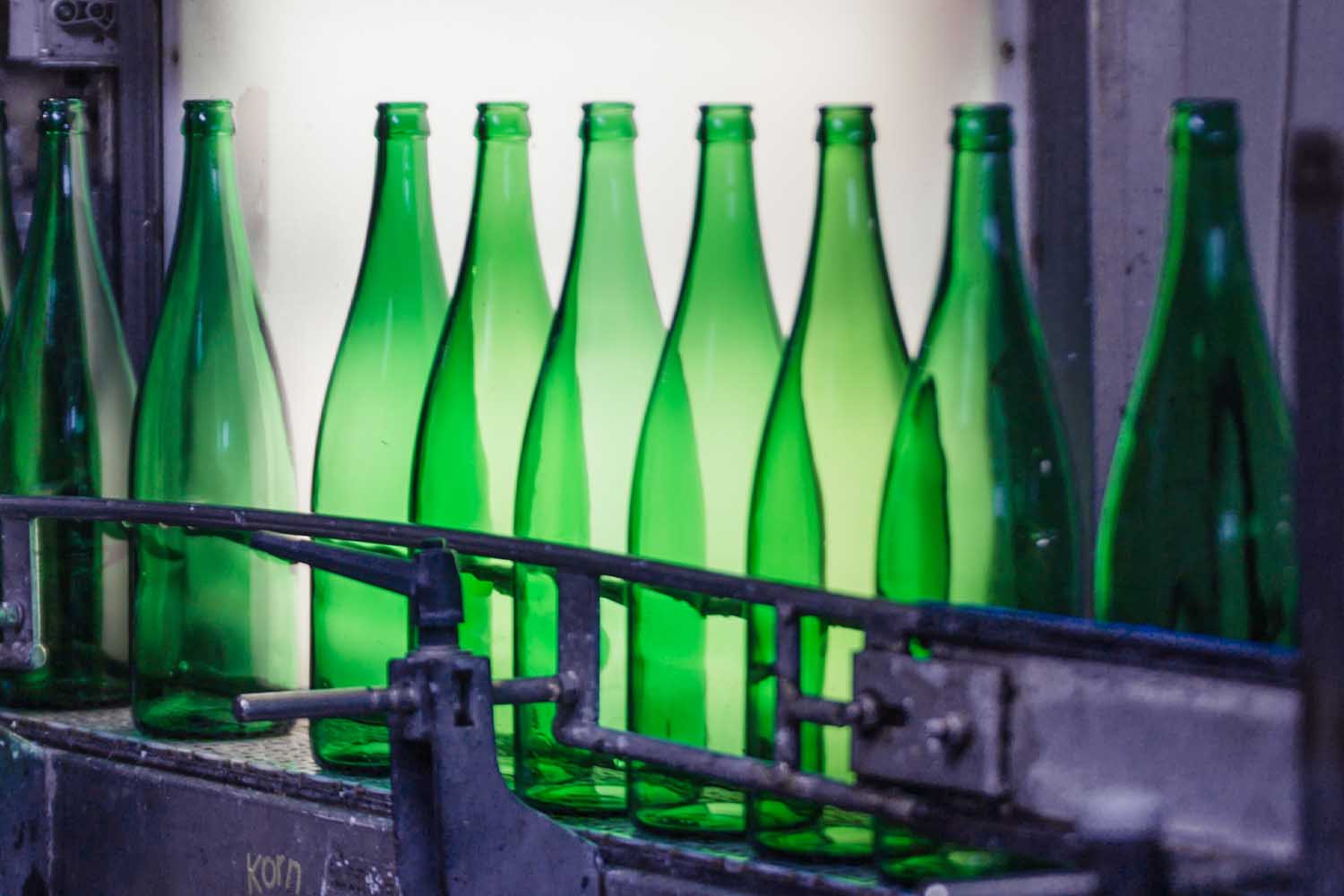
For a long time, many wineries had their own bottle-washing machines. Due to the prevalence of single-use glass bottles, most of these machines have since been dismantled. With the introduction of the new reusable bottle system, we are therefore primarily working with high-capacity, external washing centers in the wine-growing regions that already offer contract washing—and, as a rule, contract bottling as well.
Because both bottles AND crates are standardized in the new reusable system, new possibilities arise: While in traditional contract washing—in a closed-loop system—winemakers can only have their own containers cleaned, it is now possible to exchange bottles and crates. As a result, winemakers no longer have to wait for their containers to be cleaned; instead, they can immediately exchange dirty containers for clean ones at the washing center.
Because the system no longer relies solely on the use of the company’s own bottles, quality control within the cycle is becoming increasingly important. The goal is therefore also to support existing bottle-washing centers in strengthening their quality assurance systems:
Automated bottle inspection can detect even minor damage that might not be visible to the naked eye. These machines also help ensure that bottles that are excessively worn are more effectively removed from the production line.
Even though the bottles dry on their own after cleaning due to the treatment with warm lye or warm water, additional drying improves the results.
Equipment with high-performance, automated sleeve removers, if not already available.
Since bottle-washing facilities are only allowed to return undamaged bottles to their customers, the majority of rejected bottles are identified during inspections before and after washing. A 5% rate of damaged bottles is factored into the service fees. Any additional rejected bottles are typically billed to the bottle suppliers.
As part of the project, we were able to collaborate with a group of dishwashing service providers who collectively bring a wealth of experience and technical expertise to the table:
Haimerl Bottle Service (↗), Langenlois
Christian Schauhuber Bottle Service (↗), Heldenberg
Manfred Hölzl Brewery (↗), Wieselburg
Moser Wines (↗), Gols
Kerschbaum Winegrowers' Service (↗), Gedersdorf near Krems
Of course, the reusable bottle system is open to additional washing centers or private washing facilities. If you are interested in participating in the reusable bottle system, the new washing facilities will be inspected before they are put into use. For this purpose, new analytical devices from project partner Vetropack are used, which can easily measure the mechanical stress on the bottles.